Saturday, October 5, 2013

Update...

It's been a while...this year and life in general have been interesting!

Since my last post I have blown all my goals out of the water. Once I figured out that people would be interested in my knives I made certain goals for myself. One of these was to try and get a picture in a magazine some time during 2014.

Well that happened at least 4 times this year. The biggest surprise of all was being named one of Blade Magazines Makers to Watch in the March issue.

I finished up my knives for the Blade Show and had a fantastic time with friends and fellow makers.


A pile of materials from Blade and a Taurus12 acquired in a swap with Erik Markman.

 I did not make any knives purposely intending to enter judging but at the last minute I decided to enter 3 (the allowable number).

I entered a Loveless Pattern Drop Hunter in the Hunter category, a Loveless Pattern Battle Knife in the Fighter category, and a Loveless 5" Fighter in the New Maker category.


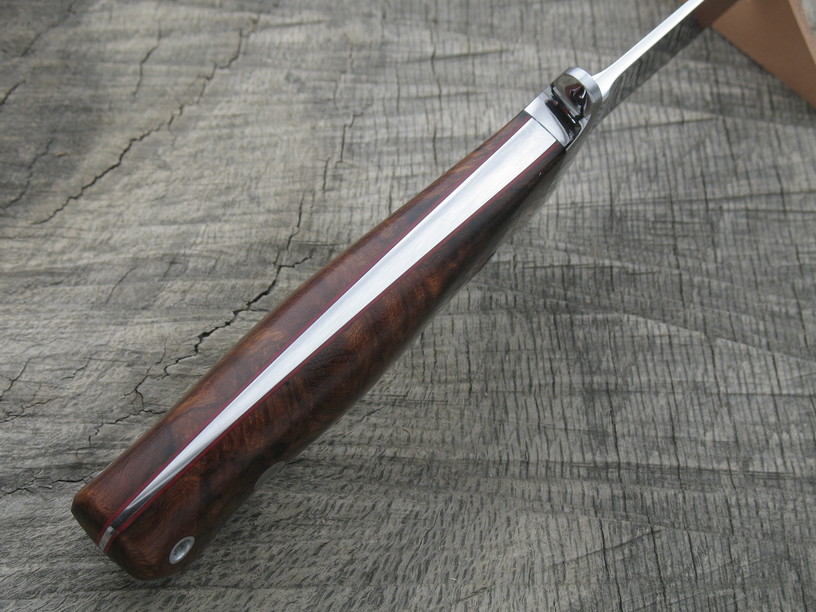
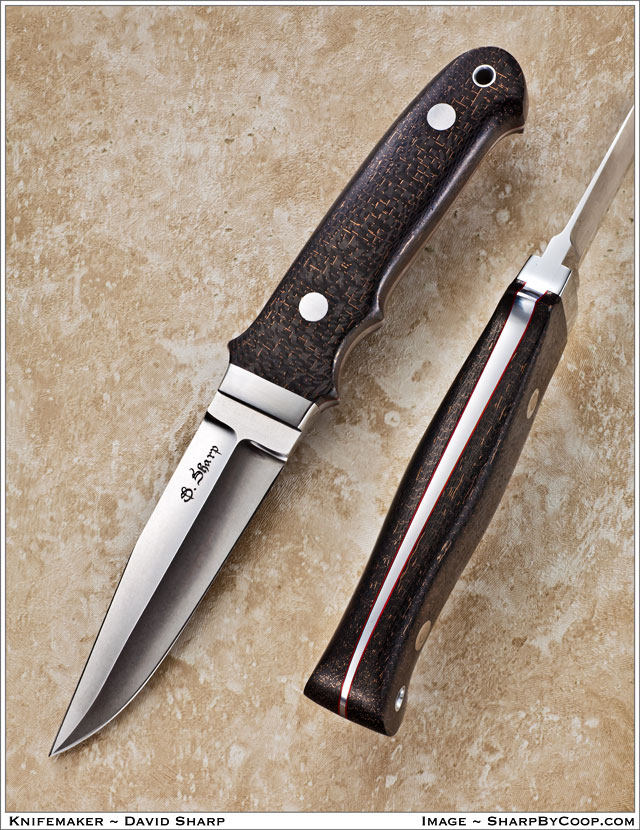
I ended up winning Best New Maker for the following knife:


I love knife making! The friendships I have developed along with the skill set acquired make me a happy person.

Thanks to all who support me and find my stuff worth purchasing!

Sunday, May 5, 2013

Getting ready for Blade'13

In '11 my grown up self got in the way of going to the Blade Show. Last year my wife insisted I go, so I did as a spectator. I went with a friend and milled around for three days. Before I left I thought I had a plan of attack; people I wanted to meet, things I wanted to look at, and stuff I wanted to buy. When I walked in the doors my plan ran out the window.  I was the proverbial kid in a candy store. When Sunday afternoon rolled around I still had stuff to do. I was very happy that for my first Blade Show I did not have a table (would have been premature also) it would have been torture.

So this year, headed towards my third year as a knife maker I have a table (13AA).  Here are some of the knives I am taking for the table or delivering.


Sunday, March 17, 2013

My Grinding Gear (Part 2)


Currently I use the KMG  primarily with the pictured attachment; in the picture configured for slack belt grinding.  The belt runs across the two rollers without any backing.  This set-up allows for blending the contours of the handle after rough shaping.

With the hardened O1 platen attached I use it for tapering tangs.  The platen that comes with this two wheel attachment is mild steel. After profiling or doing any grinding with it it quickly develops a depression which means flat grinds or tapered tans that are not flat.  So I purchased some O1 and made two fully hardened platens.  They still wear but I am fortunate enough to have a surface grinder with which I can quickly bring them back to flat.

Or with a 36" radius platen attached for full height hollow grinds on some of my beefier knife designs.  This Radius platen is made by knife maker Nathan Carothers in small batches and offered for sale every so often.  The initial thought behind these was duplicating the large stone grinding wheels of days gone by.

Next up is my GIB (Grinder In a Box). Because of its taller profile I use it primarily with the wheels for hollow grinding (it's easier on the neck and back).  It is here pictured with a 10" wheel.
A 6" and 3" wheel; I could not do what I do without these three sizes.
Of course I can't leave well enough alone so I also added a gas compression spring to this grinder also.  This is easily done by abandoning the standard tracking arm pivot hole.  I enlarged the hole provided for the tension spring and used this as my pivot.  The tracking arm is effectively longer and provides room for mounting the cylinder .
I also milled a slot in one of the two holes designated for the tracking arm bracket.  This allows the assembly to be pivoted about 1/8-1/4" for aligning the tracking wheel with the drive wheel.

To be continued...

Sunday, March 3, 2013

My Grinding Gear (Part I)

So I was told by my grandson (Titus) that I need to update my blog.  I appreciate all the people that read about my stuff but his comment kicked me into gear.

All the knife forums I frequent have often and repeated questions about what grinders are used and which is better.  I thought I would show what I use and why.

My KMG (Beaumont Metal Works) as delivered (4/10) and first installed; for those familiar with this grinder  it is belt driven.  The motor normally sits on the bench to the left of the grinder in front of the pulleys.  I did not want to lose this space so I mounted the motor under the bench on a swing plate with the belt running through the bench top.
Almost 3 yrs later and the bench is much dirtier and more crowded
If you want to make knives good lighting is a must. I have tried many set-ups including direct task lighting (too many shadows because your head is directly above your work so task lighting is to one side or the other).  The above unit seems to work best for me.  A 4 bulb fluorescent (daylight bulbs) light fixture hanging at about 6.5' (I'm 6'1")
My heavily used KMG no longer in the factory delivered condition.  It is now used primarily for  the  platen attachment and the small wheel attachement.
The KMG was modified for a number of reasons (shortcomings in my estimation).  As you can see in the above picture it has an added tool slot that came with the MAP arm attachment.  This is not in the recommended location but has been lowered to allow more fexibilty of tooling. 

A closer look shows that the factory handle has been extended and the tensioning spring has been replaced with a gas spring.  The gas spring was the brain child of Brian Fellhoelter.  To be blunt an owner of a KMG is not the sharpest tool in the shed if they don't make this modification.  The tracking is greatly improved and the harmonic/vibration experienced because of imperfect belts, rotation, and the factory compression spring is minimized if not eliminated. 
If you compare this picture to the first you will notice the motor is now mounted on the bench behind the grinder.
I removed the original KMG pulleys, bearing blocks, and shaft and  TIG welded in a plate configured for  56C motor.   I know have the only direct drive KMG I have ever seen.  This modification fixes the absurd drive arrangement of the factory KMG.  The factory drive arrangement takes up space, seems to rob significant power, and adds to the vibration I mentioned above. 
To be continued...

Sunday, October 14, 2012

No post in September because...

I got behind in preparation for the California Custom Knife Show.  It was abnormally hot in August and September and shop time was miserable.

The CCKS is in it's third year and this year was my second year holding a table.  A fitting way to mark the passing of my second year as a knife maker. I love shows because even though I am not a "people person" you get to see the look in a person's eye when you have something on your table that truly excites them.  As a new maker it is also a way to catch up with more accomplished maker for a round of constructive criticism. 

I am fortunate when it comes to shows here in So Cal that my wife hangs out with me for one day and my brother the next. I also get to hang out with my good friend Robert Scheppmman (a neighboring knife maker).

Wife and I
Four of the Loveless patterns I had on the table; T-B, Stiff Horn, Chute, Hideout, and Drop Hunter (better pics below)

Sharpwerks side of the table


David Sharp
david@sharpwerks.com

Evolution of a tool (baby steps)

So I developed the idea of the Prybuddy after purchasing a key chain pry-bar and feeling that there was something missing.  Since the first batch I have listened to my customers/friends and tried to improve the capability/useability of the product. Below is a picture of the evolution since:

L-R, The original Prybuddy, Prybuddy Camel Toe, Prybuddy XL, Prybuddy R1, and Prybuddy Edge
The original worked for what I needed it to. Myself and a few friends have been caring them since day one and I so far have had no problem with rust (O1 tool steel).

Even though nobody has complained it was brought to my attention that the corners of the pry tip may gouge your leg when carried on the key ring. This comment brought about the Prybuddy Camel Toe.

The Prybuddy XL came about at the request of a customer; he is a computer tech and carries a multi-tool daily.  The XL was sized to fit in the sheath of most multi-tool as pictured below. I am constantly striving to add more functionality to my tools so I added a notch for scraping a fire starting rod (ferrocerium rod). I have had reports that the XL version also comes in handy as a force multiplier.


Two factors brought about the Prybuddy R1.  The cap lifter worked but not as well as I would like and a friend did not like the orientation of his keys when the cap lifter was used. To facilitate this change I added a bit of width to the Prybuddy so as not to compromise the strength.


The most recent evolution was the edged version. The Prybuddy Edge can be used as a neck knife or can simply disappear in the pocket.  It is only .75" wide so it is only meant to be a convenience edge; opening boxes, cutting paper, etc... It should go with out saying that if the pry bar end is used the sheath should be in place so as not to cut yourself!


Gratuitous pic done by a friend


I am always surprised at how many people ask what the hex hole is for so I added a few pics below.

My personal EDC (Prybuddy XL, County Comm Screw Keys and A&P keyring) plus a single blade pocket knife.
The County Comm Screw Keys work well in conjunction with one of my Prybuddies

Prybuddy R1 with standard .25" driver bit

Prybuddy XL with .25" socket adapter
 If you have any ideas of how to make these tools better/more useful please let me know!

David Sharp
david@sharpwerks.com